Proctology
We diagnose, treat, and help prevent diseases of the anal region, anal canal, rectum, and colon.
A proctologist is a general surgeon who specializes in the diagnosis and treatment of diseases affecting the anus and rectum. These conditions include haemorrhoids (hemorrhoids), anal fissures, fistulas, and other anorectal disorders.
Treatment may be conservative, including lifestyle and dietary modifications, as well as medications and topical creams, or surgical, ranging from simple minimally invasive procedures performed under local anaesthesia to more complex operations requiring general anaesthesia.
When should you see a proctologist?
Disorders of the anal region and rectum are common, yet many people hesitate to seek medical advice because they feel embarrassed. However, there is no need to delay your visit due to discomfort or embarrassment. Our specialists treat every patient with professionalism, understanding, and respect.
We encourage you to book an appointment as soon as you notice the first symptoms. Early diagnosis and treatment allow us to find the most effective solution together and help prevent the condition from worsening.
You should see a proctologist if you experience:
- Your faecal occult blood test is positive (as part of colorectal cancer screening or a routine check-up);
- You experience pain or discomfort in the anal or perineal area;
- There is blood on the toilet paper or bloody discharge from the rectum;
- Lumps, fissures, or ulcers have developed in the anal area;
- You have rectal prolapse;
- You have a feeling of incomplete emptying or a sensation of a foreign body in the rectum;
- You have mucous or purulent discharge from the rectum;
- You suspect you have haemorrhoids;
- Your faecal occult blood test is positive (as part of colorectal cancer screening or a routine check-up).
Who is at increased risk?
- Women going through menopause — hormonal changes increase the risk of proctological diseases.
- People with a sedentary lifestyle and an unhealthy diet
- Pregnant women and women after childbirth
- Overweight people
- People with sedentary or standing occupations — office workers, sales assistants, drivers.
- Patients with a hereditary predisposition whose close relatives have had colorectal cancer or colon polyps.
Consultation with a proctologist
Follow-up consultation with a proctologist
Initial consultation with a proctologist
Our proctologist diagnoses and treats diseases of the anus, rectum, and colon, such as haemorrhoids, anal fissures, and rectal fistulas. In cases of detected rectal or colon tumours, we refer patients for treatment according to established clinical guidelines.
The initial consultation begins with a detailed discussion, during which we review your symptoms and medical history. This is followed by a clinical examination performed in a left lateral position with the knees drawn towards the abdomen. The doctor examines the perianal area and performs an anoscopy. The entire procedure is quick and performed with sensitivity and care.
Important information:
- Preparation is required. 1–2 hours before the appointment, you must use a Microlax micro-enema, which takes effect within approximately 15 minutes. Remove the cap from the applicator tip, gently squeeze until a small amount of liquid appears, insert the tip fully into the rectum, empty the tube, and then carefully withdraw the applicator while keeping it compressed.
- For the anoscopy examination, a pain-relieving gel is used.
Incision of a thrombosed external hemorrhoid
In the case of an external haemorrhoid thrombosis, a firm, purple, and painful lump forms in the anal area. In some cases, the thrombosis may resolve with conservative treatment using painkillers or topical creams.
When does a haemorrhoid thrombosis need to be opened?
The procedure is indicated in the following cases:
- severe, throbbing pain in the thrombosed haemorrhoid;
- a large and tense thrombosed external haemorrhoid;
- symptoms present for less than 72 hours;
- conservative treatment (e.g. ointments or pain relief medication) has not been effective.
Ligation of internal hemorrhoids
This is a minimally invasive procedure that does not require general anesthesia or hospitalisation. A small rubber band is placed around an internal haemorrhoid, cutting off its blood supply. As a result, the haemorrhoid shrinks and typically falls off within 7–10 days.
Who is this treatment suitable for?
- Grade II–III internal haemorrhoids
- Bleeding, discomfort, or prolapsing internal haemorrhoids
- Cases where conservative treatment has not been effective
Important information
- Ligation is not suitable for the treatment of external haemorrhoids.
- Bowel preparation is required using a Microlax micro-enema 2 hours before the procedure.
- f you are taking blood-thinning medication, a prior consultation is required to assess suitability and safety of the procedure.
Sclerotherapy of hemorrhoids
Hemorrhoid sclerotherapy is a quick and painless treatment method that does not require surgical intervention. During the procedure, a sclerosing agent is injected under the mucosa near the internal haemorrhoid, causing the blood vessels to constrict and close. As a result, blood flow to the haemorrhoid decreases, the haemorrhoidal tissue shrinks, and the haemorrhoid gradually regresses.
When is sclerotherapy suitable?
The procedure is suitable if:
- there is no recurrent prolapse of the haemorrhoid;
- there is recurrent mild or moderate bleeding;
- symptoms persist or worsen despite medication;
- there is daily itching, discomfort, or a burning sensation;
- the condition is Grade I–III internal haemorrhoids.
Important information
- Bowel preparation is required using a Microlax micro-enema 2 hours before the procedure.
- The procedure is quick and takes only a few minutes.
- If necessary, the procedure can be repeated after 4–6 weeks.
- Sclerotherapy can be combined with laser treatment and rubber band ligation.
Treatment of an anal fissure with a botulinum toxin injection
Treatment of anal fissure with botulinum toxin injection is one of the newer methods used for managing chronic anal fissures. Spasm of the anal sphincter reduces blood flow and impairs tissue healing, which can cause the fissure to become chronic.
The goal of the procedure is to temporarily block nerve impulses in the muscle using botulinum toxin. This helps reduce sphincter spasm, relax the anal muscle, improve blood circulation, and promote healing.
When is botulinum toxin treatment for anal fissure needed?
The procedure is indicated if:
- a chronic anal fissure has not healed after 6–8 weeks of treatment, with persistent pain and bleeding;
- it can be combined with surgical treatment if necessary.
Removal of hemorrhoidal tags or anal skin tags
After surgical treatment of haemorrhoids, anal wounds often heal with the formation of skin folds. Small residual skin tags around the anus may also develop after haemorrhoids, thrombosis, or inflammation have resolved. If these residual skin tags cause discomfort or are bothersome, they can be removed once at least 2–3 months have passed since the resolution of the haemorrhoidal condition.
Although skin tags are not dangerous, they may cause itching, irritation, as well as cosmetic and hygiene-related concerns.
When should you see a doctor?
- bothersome skin folds remain after haemorrhoid treatment;
- maintaining anal hygiene is difficult;
- you experience itching, irritation, or discharge;
- friction is felt during movement.
Important information
- The procedure is painless and performed under local anaesthesia.
- It is a quick procedure lasting 20–30 minutes.
- Wounds heal without sutures.
- Avoid alcohol and spicy foods for 2–3 days before the procedure.
- Use a Microlax micro-enema before the procedure.
- nform the doctor about all medications you are taking, especially blood thinners.
Hemorrhoid Laser Treatment
Laser Treatment of Grade 2–3 Hemorrhoids
Laser Treatment of Grade 3 – 4 Hemorrhoids
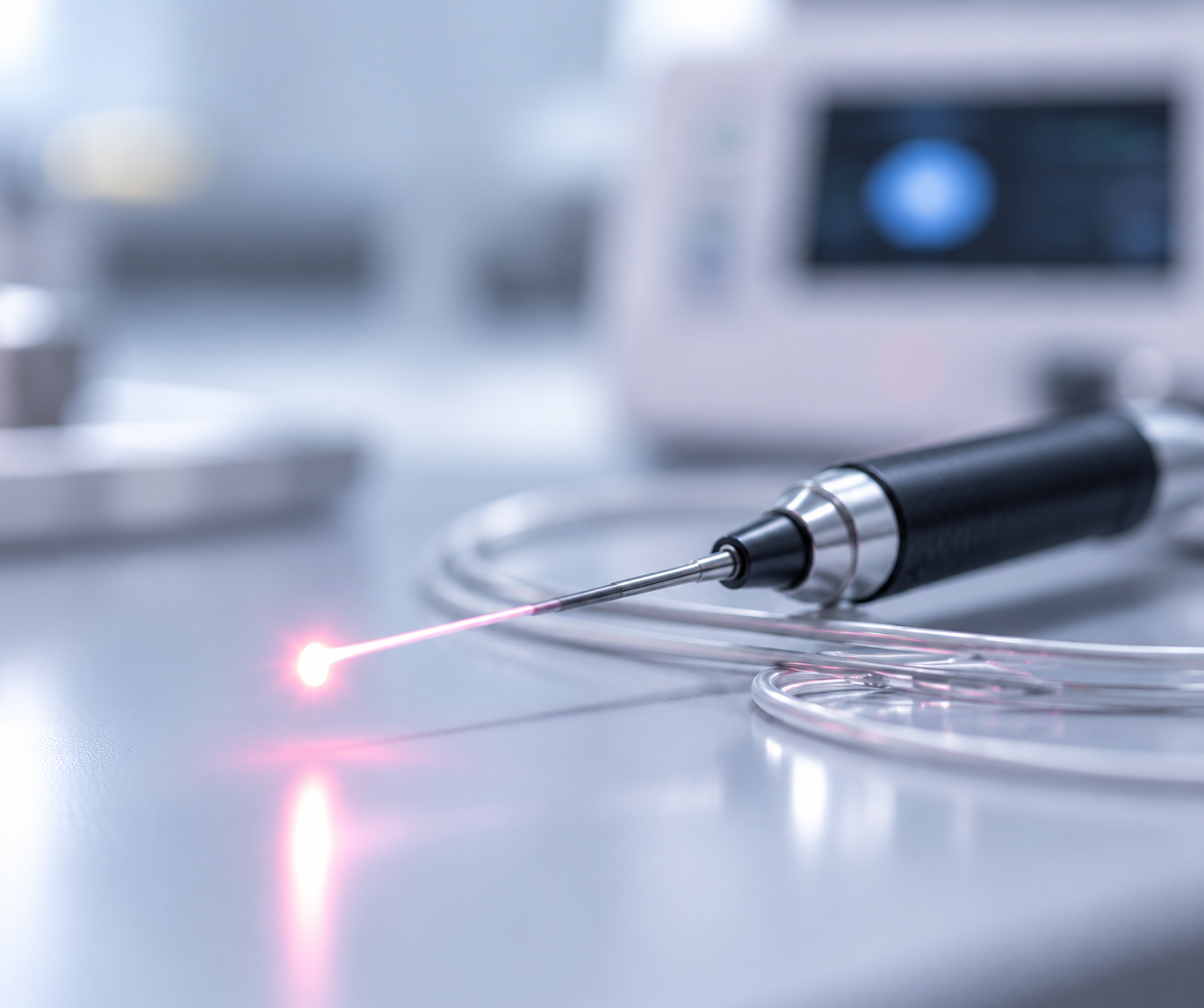
Laser treatment is a modern minimally invasive method for treating internal hemorrhoids (usually grade II–III). Minimally invasive means that no tissue is removed. Compared to traditional surgical excision, recovery after laser treatment is significantly faster and pain is reduced.
LHP (Laser Hemorrhoidoplasty) — during the procedure, laser energy causes coagulation (closure) of blood vessels and controlled thermal damage to the tissue, resulting in shrinkage and reduction of the hemorrhoidal tissue.
HELP is a laser technology aimed at the arteries supplying blood to hemorrhoids. When the blood supply is interrupted, hemorrhoids gradually shrink on their own.
Laser Treatment of Pilonidal Cyst (Sinus)
Laser treatment is an innovative procedure for the treatment of pilonidal sinus disease. The cyst tissue is treated using a minimally invasive laser device, requiring only a small incision.
A pilonidal sinus is a chronic inflammatory condition, often presenting as an abscess or infected cavity in the intergluteal cleft. The most common cause is ingrown hair (pilus = hair, nidus = nest). Hair penetrates under the skin, allowing bacteria to enter, leading to infection and pus formation that the body cannot eliminate on its own.
Forms of pilonidal sinus disease
- Mild form – barely visible externally, only small skin openings
- Acute abscess – redness, swelling, pain when sitting or walking; discharge of pus and blood
- Chronic form – no acute symptoms; skin openings with intermittent purulent or bloody discharge
Treatment of an anal fissure
Laser Treatment of Anal Fissure
Surgical Treatment of Anal Fissure
Laser treatment of an anal fissure is a minimally invasive treatment method in which a chronic anal fissure is treated using laser energy. The aim of the laser is to remove damaged tissue, stimulate tissue healing, and promote closure of the fissure.
The procedure is performed under general anesthesia. The laser allows the damaged area to be treated precisely while minimizing trauma to the surrounding healthy tissue. If necessary, laser treatment can be combined with a botulinum toxin injection to reduce anal sphincter spasm and create better conditions for the fissure to heal.
Compared with conventional surgical treatment, laser treatment is less traumatic, postoperative pain is generally less severe, and recovery is faster.
When is laser treatment of an anal fissure necessary?
Laser treatment of an anal fissure may be appropriate if:
- the anal fissure does not heal with conservative treatment (ointments, dietary changes, regulation of bowel movements),
- persistent or recurrent pain and/or bleeding occurs,
- the fissure is chronic,
- a minimally invasive treatment method is preferred in order to reduce trauma to the surrounding tissues.
Fissurectomy, or surgical treatment
A fissurectomy is a surgical procedure in which the anal fissure, meaning the painful ulcer at the anal opening, is removed. The operation is performed when the anal fissure no longer heals on its own or with medication and causes pain, bleeding, or inflammation.
The operation is performed under general anesthesia, during which the edges of the ulcer are removed. If necessary, the procedure can be combined with a botulinum toxin injection or with reconstruction of the defect after removal of the ulcer (covering the defect with other tissue).
When is surgery for an anal fissure necessary?
Surgery to remove an anal fissure is necessary if:
- the anal fissure does not heal with conservative treatment (ointments, dietary changes, regulation of bowel movements),
- persistent pain or bleeding occurs,
- the fissure tends to recur,
- chronic inflammation or scar tissue develops and prevents healing.
What do you need to know before coming for surgery?
The operation is performed under general anesthesia.
Follow the preoperative preparation instructions provided to you!
Surgical Treatment of Hemorrhoids
Haemorrhoidectomy is a surgical procedure in which haemorrhoidal tissue is removed. The operation is performed when haemorrhoids cause severe pain, itching, bleeding, or no longer respond to other treatments (such as creams, suppositories, or minimally invasive procedures).
Haemorrhoidectomy is performed under general anaesthesia.
When is surgical removal of haemorrhoids needed?
Surgery is indicated if:
- previous treatment methods (e.g. ointments, rubber band ligation, or other minimally invasive procedures) have not been effective;
- the condition recurs after previous treatment;
- there are Grade IV internal haemorrhoids (prolapse during every bowel movement and do not reduce spontaneously);
- other treatment options are not possible or suitable;
- the haemorrhoidal tissue is large and the patient prefers a single definitive procedure.
Surgical Removal of Polyps in the Lower Rectum
When is surgery necessary?
Polyps of the anal canal and lower rectum can be surgically removed. Depending on the size and location of the polyps, the procedure may be performed under local or general anaesthesia. All removed polyps are sent for histological examination (tissue analysis). Removal of adenomatous (precancerous) polyps helps prevent colorectal cancer.
Surgery is necessary if:
- the polyps cannot be removed endoscopically;
- he polyp is causing symptoms or discomfort.
Laser treatment of genital warts
Laser Treatment of Genital Warts (1–5 lesions)
Laser Removal of Genital Warts (6–10 lesions)
Postoperative follow-up appointment
Postoperative follow-up is an important part of the recovery process. It allows the doctor to assess healing and make sure that recovery is progressing as expected.
The first postoperative follow-up visit is free of charge. If necessary, additional follow-up visits can be arranged and are subject to a fee.
During the follow-up visit, the doctor assesses the healing of the surgical area, the patient’s general condition and provides recommendations for further recovery. If necessary, the doctor will advise on any further treatment or monitoring.
- First postoperative follow-up — free of charge
- Subsequent follow-up visits — according to the current price list
Discreet help without embarrassment, modern treatment options.

Modern Proctology
Laser technologies for less pain and faster recovery.
You are not alone with Your concern
Problems in the anal area are very common and, in most cases, can be treated successfully.
Our experienced doctors will help you find the treatment solution that is right for you.